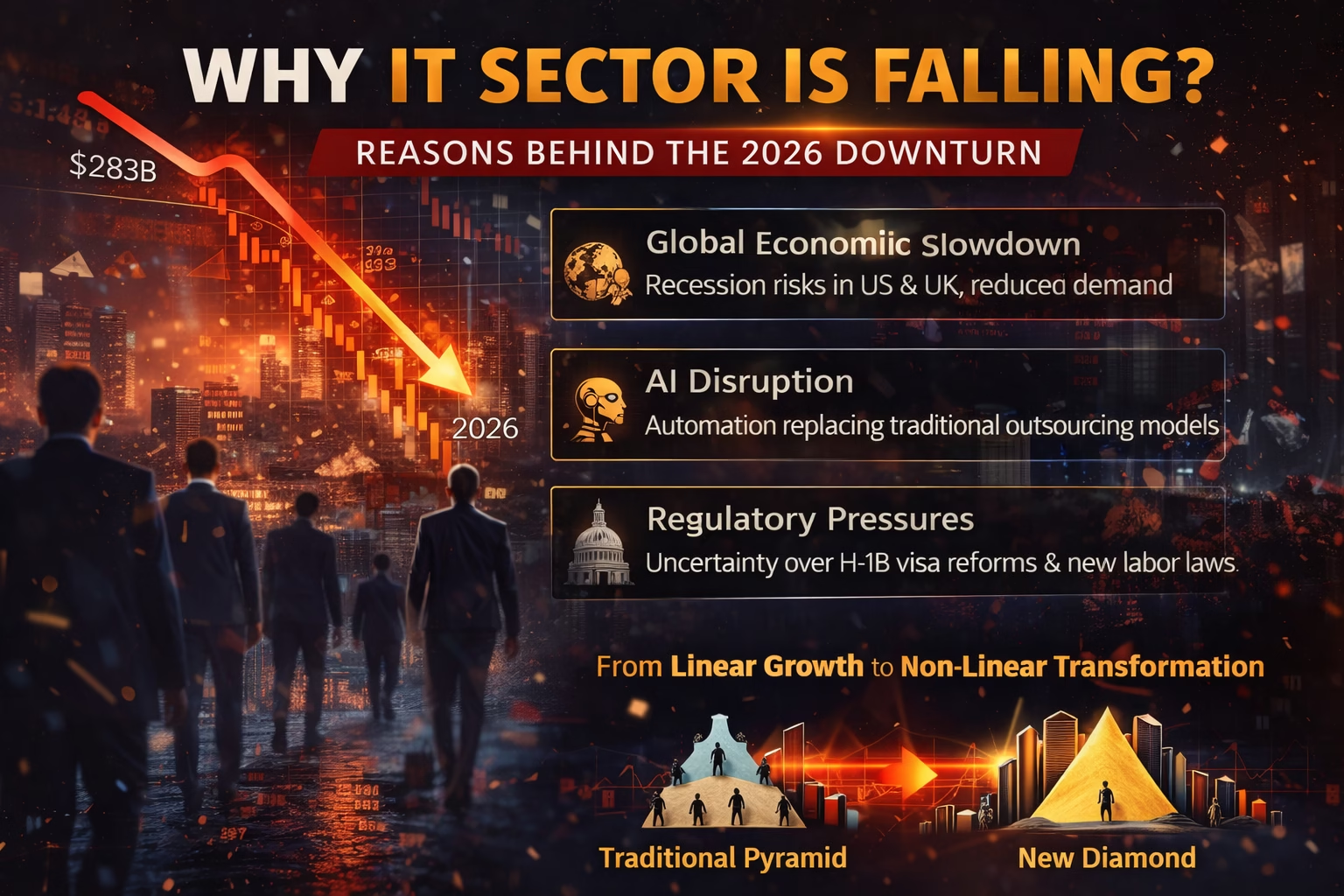

If you are searching for why IT sector is falling in 2026, you are not alone. Investors, employees, and analysts are all asking the same question. The Indian IT industry, which generates nearly $283 billion in annual revenue, is going through a visible correction phase. Stock prices have softened, hiring has slowed, and growth expectations have been revised downward.
However, to properly understand why IT sector is falling, we need to look beyond headlines and examine the deeper structural changes reshaping the industry.
Table of Contents
Global Economic Slowdown Is Pressuring Demand
One of the biggest reasons why IT sector is falling is global macroeconomic uncertainty. Recessionary risks in the US and UK during early 2026 led enterprises to postpone large-scale technology transformation projects. Instead of aggressive expansion, companies shifted toward cost optimization and risk management.
Because Indian IT companies derive a large share of their revenue from North America and Europe, any slowdown in those economies directly impacts deal pipelines. When global clients delay spending, revenue visibility weakens. Financial markets react quickly to such signals, resulting in stock price corrections.
This cyclical slowdown is a key factor behind why IT sector is falling in the near term.
AI Disruption Is Changing Investor Perception
Another powerful reason why IT sector is falling is the rapid advancement of Generative AI. AI tools can now write code, automate testing, manage documentation, and even handle support functions. This technological leap has raised concerns about the sustainability of traditional outsourcing models.
For decades, Indian IT growth was built on a headcount-based model—more engineers meant more billing hours and higher revenue. With AI automating routine tasks, investors are questioning whether this model will continue to deliver the same growth trajectory.
The fear is not that IT companies will disappear, but that margins and hiring growth may moderate during the transition. This uncertainty has triggered valuation compression across the sector.
The End of the Traditional Pyramid Model
To truly understand why IT sector is falling, we must acknowledge the structural shift within workforce design. Historically, Indian IT companies followed a pyramid structure—large entry-level hiring at the base, mid-level managers in the middle, and a small leadership layer at the top.
Now, automation is reducing the need for bulk entry-level hiring. The industry is gradually shifting toward a diamond-shaped structure with a stronger middle layer of experienced professionals who can supervise AI-generated outputs.
This transition phase can temporarily slow hiring growth and create the impression of weakness. In reality, it represents productivity improvement rather than decline.
Regulatory Pressures Are Adding to Uncertainty
Another factor contributing to why IT sector is falling is regulatory uncertainty in key markets like the United States. Proposed H-1B visa reforms and discussions around measures like the HIRE Act have created concerns about delivery models that rely on offshore talent.
As companies localize hiring and expand onshore presence, cost structures are adjusting. During this transition, margins can face short-term pressure. Markets often react negatively to such uncertainties, even if the long-term strategy remains sound.
Click on the picture below to Open Demat account with Zerodha

Massive Investments Signal Long-Term Commitment
While short-term concerns dominate headlines, India is simultaneously making large-scale strategic investments to strengthen its AI ecosystem.
Adani Group has committed $100 billion to develop green-energy-powered hyperscale AI-ready data centers by 2035. This move positions India as a potential global compute hub.
Similarly, Tata Consultancy Services is investing $6.5 billion in AI data centers with up to 1 gigawatt capacity, marking a shift from its traditional asset-light model toward infrastructure ownership.
These investments demonstrate that while the market asks why IT sector is falling, industry leaders are preparing for the next phase of growth.
Digital Public Infrastructure and AI Sovereignty
India is also expanding its digital public infrastructure under initiatives like India Stack 2.0. Platforms such as BHASHINI are using AI to provide language translation across 22 Indian languages, while ONEST focuses on democratizing access to education and skilling.
These initiatives reflect a broader ambition: AI sovereignty. India aims to move from being a consumer of AI tools to becoming a creator and exporter of AI-driven intelligence. This strategic shift is central to understanding why IT sector is falling now—it is transitioning from labor arbitrage to intelligence arbitrage.
Non-Linear Growth Is the New Reality
Perhaps the most fundamental reason why IT sector is falling is the shift from linear to non-linear growth. In the past, revenue scaled directly with employee count. Today, automation allows companies to grow revenue without proportional hiring increases.
Several firms have reported strong revenue growth with minimal headcount expansion. While this improves productivity and margins over time, markets are still adjusting to the new growth narrative.
The correction we are witnessing may be less about weakness and more about recalibration.

Conclusion: Reset, Not Collapse
So, why IT sector is falling in 2026?
It is falling because global demand has softened, AI is reshaping business models, regulatory risks are rising, and investors are recalibrating expectations. At the same time, companies are investing heavily in AI infrastructure and repositioning themselves for long-term competitiveness.
This is not the story of decline. It is the story of transformation.
The Indian IT sector is undergoing a structural reset. Short-term volatility is visible, but long-term fundamentals remain anchored in digital transformation, AI infrastructure, cybersecurity, and cloud modernization.
Understanding why IT sector is falling requires seeing the bigger picture: the industry is evolving—and evolution often looks like disruption before it looks like growth.
Disclaimer: The information provided in this article is for educational and informational purposes only and should not be considered financial or investment advice. Market outlooks, projections, and opinions are based on publicly available data at the time of writing and may change without notice due to evolving market conditions. Readers are advised to conduct their own research or consult a qualified financial advisor before making any investment decisions. The author and publisher are not responsible for any financial losses arising from the use of this information.

