
Table of Contents
Secret Adani Investment – How the Controversy Began
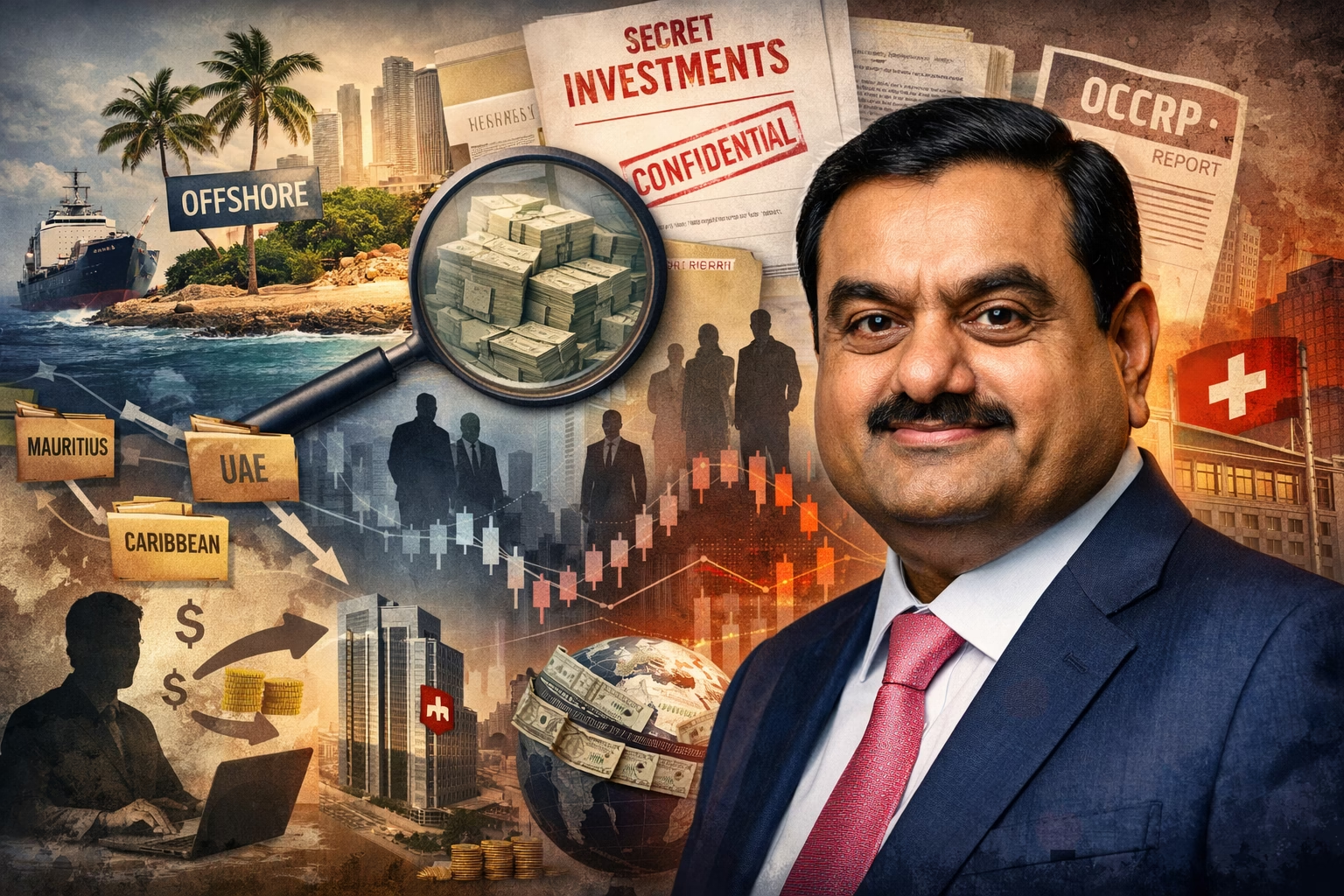
The global financial landscape was shaken in early 2023 when Hindenburg Research published a scathing report accusing the Adani Group of orchestrating what it called the “largest con in corporate history.” At the center of the storm was the allegation of a vast Secret Adani Investment network involving offshore shell entities, circular trading, and stock price manipulation.
While the Adani Group strongly denied these claims, further investigative reports by the Organized Crime and Corruption Reporting Project (OCCRP) and the Financial Times (FT) pointed to what they described as a “secret paper trail” that allegedly illuminated layers of hidden financial structures.
The phrase Secret Adani Investment has since become shorthand for the complex offshore financial arrangements that critics argue were used to manipulate market perception and capital flows.
The “Puppet Master” Allegation
A major component of the Secret Adani Investment narrative revolves around Vinod Adani, the elder brother of Gautam Adani.
Though officially stated to have “no role in day-to-day affairs” of listed companies, investigative sources claim Vinod Adani was linked to at least 38 Mauritius-based shell companies, along with entities in Cyprus, UAE, Singapore, and Caribbean tax havens.
According to these reports, the alleged Secret Adani Investment structure served three key functions:
- Stock Manipulation: Moving billions into Adani stocks to inflate share prices.
- Laundering and Siphoning: Routing funds between private and public entities to strengthen balance sheets.
- Regulatory Evasion: Circumventing India’s rule requiring at least 25% minimum public shareholding in listed firms.
If accurate, these structures would have allowed strategic control while appearing compliant with public float norms.
Secret Adani Investment Through Shells and “Public” Funds
Investigations suggest that the Secret Adani Investment strategy involved “stock parking” entities designed to simulate healthy public ownership.
One example cited was Monterosa Investment Holdings, which reportedly controlled five independent funds holding over $4.5 billion worth of Adani shares. These funds reportedly had minimal web presence, no visible staff, and portfolios heavily concentrated in Adani companies.
Similarly, Elara Capital Plc operated funds where Adani stocks allegedly made up nearly 99% of holdings. A former trader reportedly described it as “obvious” that the shares were effectively controlled, structured specifically to conceal beneficial ownership.
These entities accounted for between 30% to 47% of yearly trading volume in certain Adani stocks, raising allegations of wash trading or artificial liquidity generation within the broader Secret Adani Investment ecosystem.
The Ahli–Chang Link
New revelations in 2023 and 2026 further expanded the Secret Adani Investment narrative.
Reports linked two individuals—Nasser Ali Shaban Ahli and Chang Chung-Ling—to large offshore trades in Adani shares via Bermuda’s Global Opportunities Fund.
Documents indicated these associates controlled at least 13% of free float in three of four Adani-listed firms at the time. Swiss banking records reportedly showed holdings worth nearly $3 billion in Adani stock as recently as 2023.
Investigators described this as a “Russian doll” structure—layers of funds and shell entities allegedly managed by employees linked to Vinod Adani. The core question: were these independent investors, or frontmen in a larger Secret Adani Investment structure designed to bypass insider trading and ownership disclosure rules?
Money In, Money Out
The alleged Secret Adani Investment framework also included questionable capital flows:
- Krunal Trade & Investment (Mauritius): Lent $253 million to an Adani private entity, which then lent $138 million to Adani Enterprises.
- Emerging Market Investment DMCC (UAE): A shell company reportedly lent $1 billion to a subsidiary of Adani Power.
- Growmore Trade and Investment: Controlled by Chang Chung-Ling, it reportedly gained $423 million overnight through a stock merger with Adani Power.
- PMC Projects: Previously described as a “dummy firm” in a 2014 investigation, it generated $784 million from Adani-linked projects and was reportedly connected to Chang Chien-Ting, son of Chang Chung-Ling.
These transactions allegedly bypassed related-party disclosure norms, reinforcing claims of a highly coordinated Secret Adani Investment cycle.
Regulatory Lapses
A pressing question remains: how could such a large alleged structure operate for decades?
Investigative sources point to:
- Audit Red Flags: The auditor Shah Dhandharia reportedly had just four partners and eleven employees. Some audit signatories were only 23 or 24 years old when approving multi-billion-dollar accounts.
- Frequent CFO Changes: Adani Enterprises reportedly saw five CFOs in eight years.
- Stalled Investigations: The Directorate of Revenue Intelligence (DRI) allegedly investigated fraud in diamond trading, iron ore exports, and equipment over-invoicing totaling $17 billion, but several probes were stalled or dismissed.
Critics argue these systemic gaps allowed the Secret Adani Investment machinery to function largely unchecked.
SEBI’s Evolving Response
India’s market regulator, the Securities and Exchange Board of India (SEBI), has intensified scrutiny.
- In May 2025, SEBI threatened Mauritius-based funds including Elara India Opportunities and Vespera with penalties and possible license cancellation for failing to disclose shareholder details.
- In October 2024, SEBI proposed tighter rules targeting Offshore Derivative Instruments (ODIs or P-Notes) to prevent regulatory arbitrage and enforce Minimum Public Shareholding compliance.
These steps suggest regulators are attempting to address vulnerabilities exposed by the Secret Adani Investment controversy.
Click on the picture below to Open Demat account with Zerodha

The Adani Counter-Narrative
The Adani Group firmly rejects all allegations tied to the Secret Adani Investment claims.
The conglomerate describes the reports as a “calculated attack on India” and its institutions. It emphasizes that it is not a party to US SEC proceedings involving Gautam and Sagar Adani, clarifying that those cases focus on individuals, not listed entities.
Adani maintains that:
- All operations comply with local laws.
- Public shareholding norms are met.
- Disclosure requirements are fully followed.
The group positions itself as a driver of infrastructure growth and economic development, rejecting the portrayal of a clandestine offshore empire.

Conclusion: The Broader Impact of the Secret Adani Investment Debate
The Secret Adani Investment saga highlights deep tensions within India’s capital markets.
On one side stands a conglomerate credited with infrastructure expansion and economic growth. On the other are allegations of a vast offshore financial network involving shell entities, opaque funds, and circular transactions.
As regulators, journalists, and global investors continue examining the claims, the real issue extends beyond one corporate group. The controversy underscores the importance of:
- Transparency in ownership structures
- Strong audit oversight
- Effective regulatory enforcement
- Safeguards against concentrated corporate power
Whether the Secret Adani Investment allegations ultimately hold in courts or regulatory findings, the episode has already reshaped investor perception and reignited debate on governance standards in emerging markets.
Disclaimer: The information provided in this article is for educational and informational purposes only and should not be considered financial or investment advice. Market outlooks, projections, and opinions are based on publicly available data at the time of writing and may change without notice due to evolving market conditions. Readers are advised to conduct their own research or consult a qualified financial advisor before making any investment decisions. The author and publisher are not responsible for any financial losses arising from the use of this information.

