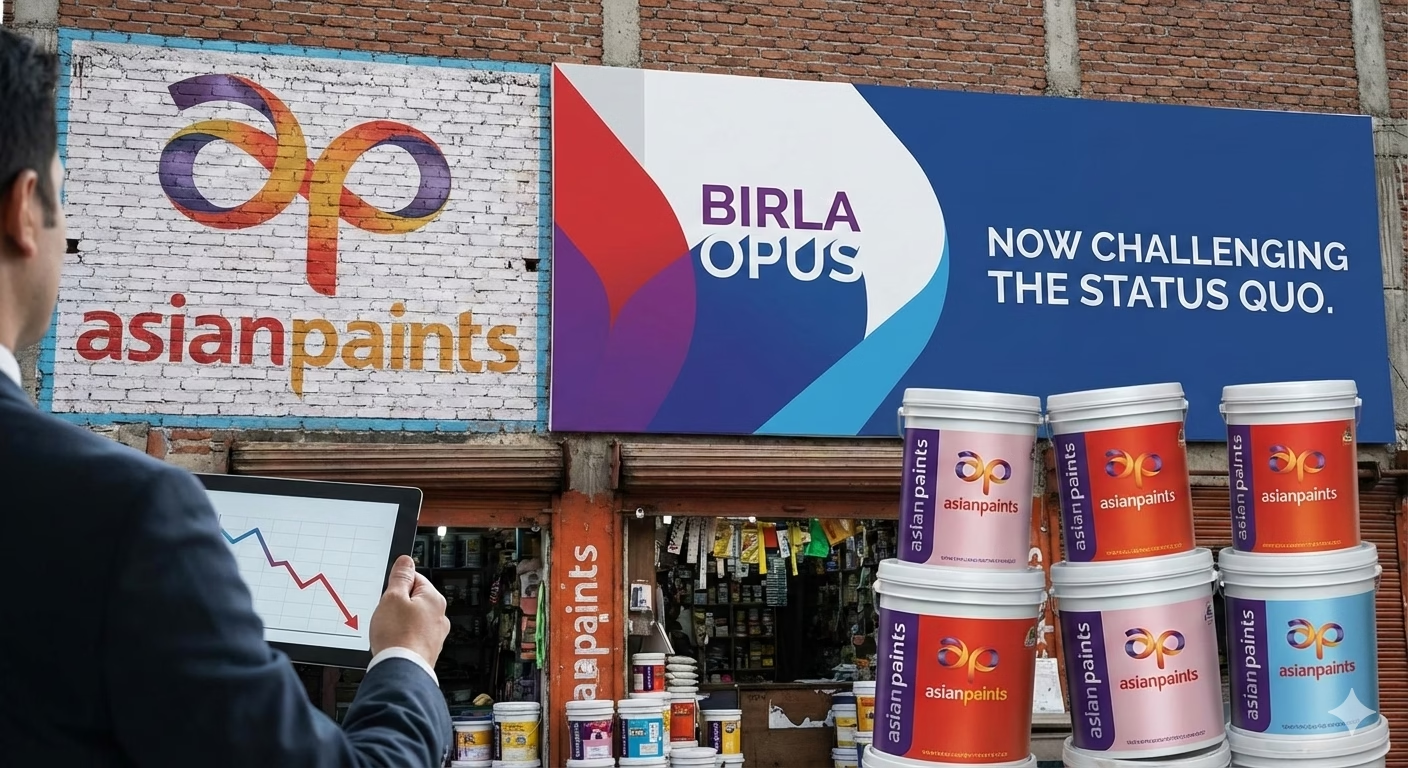

The Indian paint industry is witnessing one of its most intense competitive cycles in decades. For over twenty years, Asian Paints has been synonymous with dominance in the decorative paints market, building a formidable moat through distribution depth, supply chain excellence, premium branding, and data-driven dealer engagement. However, the entry of Birla Opus in 2024 has disrupted this equilibrium in a manner few incumbents have previously experienced. The scale, speed, and aggression of this challenge have led to measurable market share erosion and structural pricing pressure across segments.
Table of Contents
Asian Paints Struggles
Asian Paints’ decorative paints market share declined from approximately 59% in FY24 to nearly 52–55% within a year of Birla Opus’ launch. In absolute terms, this represents a significant 7% shift in industry share—an extraordinary movement in a category historically characterized by stability. Birla Opus rapidly scaled to nearly 6.8–7% market share, aided by a ₹10,000 crore investment that enabled simultaneous capacity creation rather than phased expansion. Its manufacturing plants were strategically located near key consumption clusters where Asian Paints historically held strength, thereby compressing delivery timelines and logistics costs. This proximity model allowed Birla Opus to compete not only on price but also on service efficiency, an essential lever in the decorative paints market.
The real battlefield, however, has been dealer economics. The paint industry in India operates on a dense dealer network where retailer loyalty often hinges on margins, working capital flexibility, and credit terms. Birla Opus deployed an aggressive dealer acquisition strategy offering 9–12% in-bill discounts compared to Asian Paints’ 1–2%. It also removed volume commitment clauses for three years, easing risk for dealers shifting portfolios. Reduced GST working capital burden and favorable credit cycles made the proposition financially compelling. Several anecdotal reports from Tier-2 cities illustrate this shift: dealers who once derived 70% of revenue from Asian Paints reduced allocation to nearly 30%, prioritizing Birla Opus due to improved profitability per litre sold. Such transitions underscore the economic rationality governing channel behavior.
Asian Paints Strategy on price war
Despite this erosion, Asian Paints has consciously avoided entering a price war. Management has articulated a strategy centered around sustainable value creation rather than reactionary discounting. This approach reflects confidence in structural advantages that competitors may struggle to replicate quickly. Asian Paints commands approximately 1.69 lakh retail touchpoints—an unparalleled distribution network in the Indian paint industry. Its automated tinting infrastructure, rural penetration strategy, and contractor engagement apps create ecosystem stickiness that extends beyond mere pricing.
Innovation remains central to the company’s competitive defense. New product launches have contributed roughly 16% of FY26 revenues, reflecting a deliberate push toward premiumization. Products such as Apex Ultima Protek with graphene-based exterior durability and WoodTech PU Gold with termite-resistant properties signal an attempt to differentiate on performance rather than price. The company’s R&D investments, exceeding ₹120 crore annually, are focused on nanotechnology coatings, waterproofing solutions, and environmentally sustainable formulations. Capacity expansions in Mysuru and Vizag further indicate long-term confidence in volume growth, even amid current competitive stress.
Another critical pillar of Asian Paints’ strategy is diversification. Historically reliant on decorative paints, the company has expanded into waterproofing, adhesives, construction chemicals, bath fittings, and modular kitchens under its Beautiful Homes initiative. This multi-category approach reduces dependence on a single revenue stream while increasing wallet share from homeowners. The launch of AP Assure, a digital B2B solutions platform for construction professionals, further strengthens relationships across the value chain. These initiatives elevate Asian Paints from a product manufacturer to a comprehensive home solutions provider.
Click on the picture below to Open Demat account with Zerodha

The warranty strategy, often highlighted in marketing campaigns, presents a nuanced picture. While Asian Paints promotes long-duration warranties—ranging from 4 to 25 years on select waterproofing and exterior products—the coverage tapers after the first year. This structure mirrors competitor offerings, limiting differentiation. Consumer sentiment on warranty claims has been mixed, with complaints around claim processing delays and partial coverage reductions. While warranties reinforce brand perception in premium segments, there is limited evidence that they have materially stemmed market share loss in price-sensitive geographies.
From a financial standpoint, resilience remains evident despite pressures. Q3 FY26 revenue grew modestly by 3.9% year-on-year to ₹8,849 crore, and analysts expect Q4 FY26 revenues between ₹89,000–94,000 million. EBITDA margins are projected at 18–20%, reflecting disciplined cost management even as raw material volatility and discount-driven competition persist. A recent 43% jump in quarterly profit indicates operational leverage and efficiency in procurement and backward integration.
Outlook for the near term
The Asian Paints share price outlook remains cautiously optimistic. Consensus targets hover near ₹2,420, with a broader range between ₹1,900 and ₹2,900 depending on competitive intensity and demand revival. Near-term risks include further market share decline toward 50%, continued dealer incentive escalation, and muted urban housing demand. Conversely, rural recovery, premium product adoption, and scaling of non-paint businesses could restore growth momentum by late 2026.

Strategically, the Indian paint industry appears to be transitioning from a near-monopolistic structure to a multi-polar competitive environment. Birla Opus has demonstrated that capital intensity combined with channel aggression can rapidly alter market dynamics. However, sustaining such aggression requires long-term margin tolerance. If discounting moderates, Asian Paints’ entrenched distribution network, brand equity, supply chain analytics, and economies of scale in raw material procurement could reassert leadership stability.
Conclusion
Asian Paints is no longer operating in a comfort zone of uncontested dominance. Yet, it remains structurally advantaged relative to peers. The company’s decision to prioritize innovation, premiumization, and ecosystem expansion over short-term price retaliation reflects strategic maturity. The coming fiscal year will be decisive in determining whether recent market share erosion represents a cyclical disruption or a permanent recalibration of the Indian decorative paints market. For investors, analysts, and industry observers, the unfolding competition between Asian Paints and Birla Opus stands as a compelling case study in competitive strategy, capital deployment, and brand resilience within India’s evolving consumer landscape.
Disclaimer: The information provided in this article is for educational and informational purposes only and should not be considered financial or investment advice. Market outlooks, projections, and opinions are based on publicly available data at the time of writing and may change without notice due to evolving market conditions. Readers are advised to conduct their own research or consult a qualified financial advisor before making any investment decisions. The author and publisher are not responsible for any financial losses arising from the use of this information.

